
The complete guide
Choosing an Anker Power Bank for Everyday Charging
A low phone battery can turn a simple day out into a search for a wall socket. It is more awkward when you still need your phone for tickets, messages or the journey home. A portable power bank gives you another charging option without making a nearby socket part of every plan.
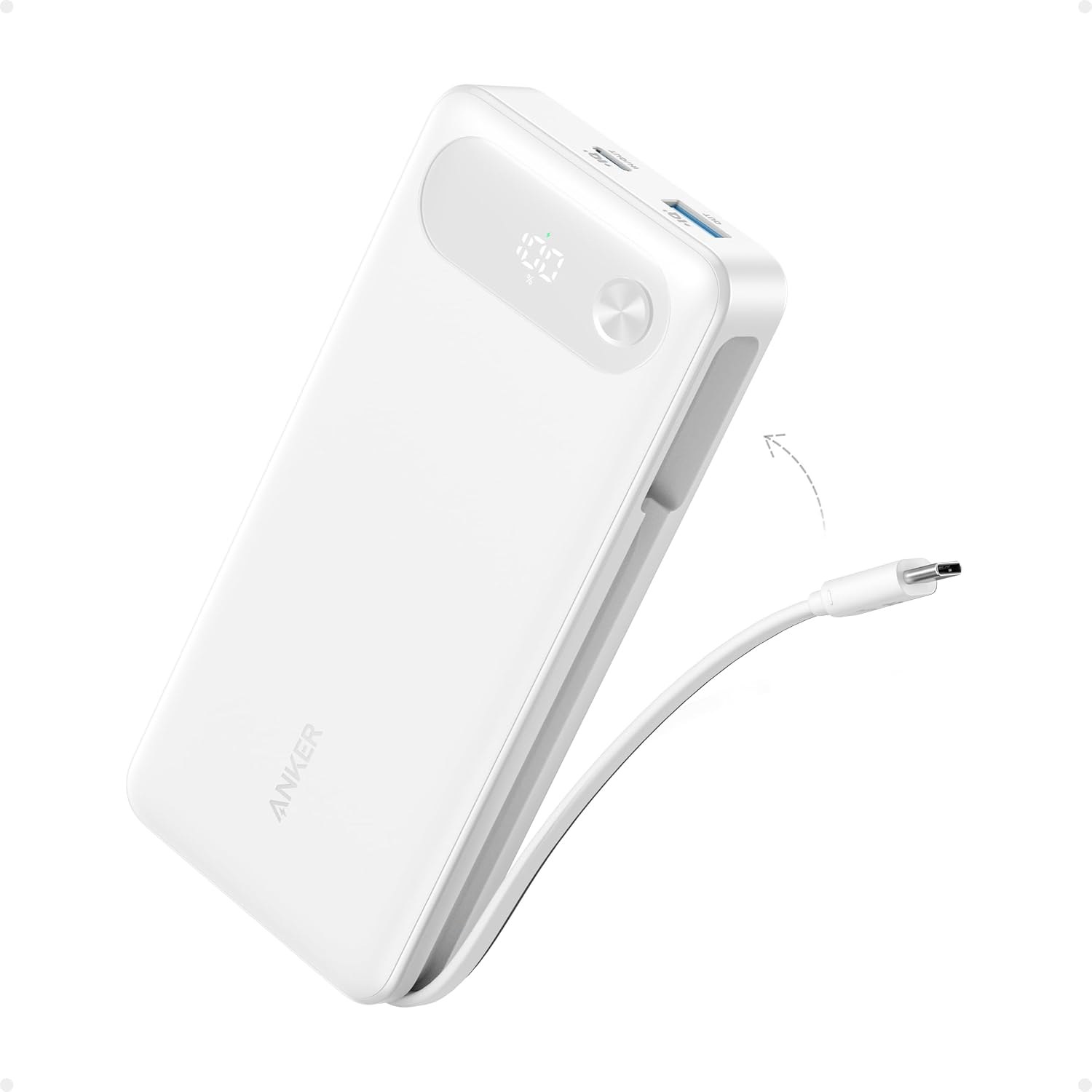
The Anker 20,000mAh 87W Power Bank, White is model A1383. It combines nominal internal capacity of 20,000mAh with a built-in USB-C cable and separate USB-C and USB-A ports. Those details are useful starting points, but choosing well means looking beyond the largest number on the page.
This guide explains what the stated figures mean, what to check against your devices and which details remain unspecified.
Start with the devices you actually carry
Before choosing a battery pack, think about what needs charging during a normal day. A phone used for messages has different demands from a laptop. You may also want to charge more than one device, which makes the total output relevant.
Look at each device's charging instructions. Check the connector type and power requirements rather than assuming that a matching plug guarantees the result you want. A USB-C connection alone does not tell you how quickly a device will charge.
This USB C battery pack offers a built-in USB-C cable, plus USB-C and USB-A ports. That gives you several connection choices. Your device and cable still need to suit the charging setup.
What 20,000mAh tells you
The stated 20,000mAh figure describes nominal internal battery capacity. It helps identify the type of battery pack you are considering, but it is not a count of full phone charges.
There is no fixed charge count promised for this Anker model. Different devices have different batteries, and using a device while charging changes the result. A claim that it will charge every phone a set number of times would not be supported by the available details.
For a useful comparison, keep capacity separate from speed. Capacity concerns stored charge, while the output figures describe the power available for charging. A 20000mAh power bank should be judged on both, along with its connections and your own needs.
If you need a guaranteed amount of charging for a specific trip, do not base that plan on the capacity figure alone.
Understanding 87W combined and 65W single output
This model has a maximum combined output of 87W. Its stated maximum for a single USB-C output is up to 65W. These figures describe different limits and should not be treated as interchangeable.
The 87W figure does not mean every connected device receives 87W. Nor does it mean that one USB-C connection supplies that amount. Actual charging depends on the device and cable.
If you are comparing a 65W USB-C power bank with another charger, check your device's own requirements first. A higher stated output is not a promise that every phone will charge faster. The device must support the charging arrangement.
A detailed power-sharing table is not provided here. If a particular mix of devices and outputs is essential, confirm those details before ordering. That is more useful than making assumptions from the combined rating.
Why the built-in cable matters
A power bank with built-in cable can reduce the chance of having a battery pack but no cable to connect it. On this model, that attached cable is USB-C.
It is a practical feature if your device uses a suitable USB-C charging connection. You can keep the attached connection with the battery pack instead of remembering a separate cable for that task.
The built-in cable does not remove every compatibility check. You still need to confirm that your device accepts the connection and that the charging output suits it. Devices with other connectors may need a suitable separate cable through one of the ports.
Treat the attached cable with care. Avoid pulling the power bank by it or forcing it into a tight bend when packing.
Making use of the separate ports
Alongside the attached cable, the power bank has USB-C and USB-A ports. These allow you to choose a connection that works with an appropriate separate cable.
This can matter if your everyday devices use different cable arrangements. Rather than buying by the phrase “USB charger” alone, check the ends of the cables you already own and the requirements of the devices they serve.
Cable choice also affects actual charging. A cable that fits physically should not be taken as proof that it supports the output you expect. Check its specifications when charging speed matters.
The available details do not establish every possible device combination. For a precise multi-device setup, ask for confirmation rather than assuming how power will be divided.
Who this model may suit
This Anker power bank may suit someone who regularly needs charging away from a socket and wants an attached USB-C cable. The separate ports also give options for devices connected by suitable cables.
It is worth considering for commuting, days out or travel, provided your devices match its charging connections and output. For laptop use, pay particular attention to the laptop's charging requirements. Up to 65W single USB-C output is not a guarantee for every laptop.
Do not assume it will fit a jacket pocket or feel light in a small bag. Weight and dimensions are not specified here. Those details can be as important as output when you carry a battery pack all day.
If pocket fit is a firm requirement, confirm the measurements before buying.
Check what is not specified
A careful buying decision includes the missing details. This white power bank has a stated model, capacity, connections and output limits. Its casing material and country of origin are not specified.
A wall charger is not guaranteed to be included. If you need one, check the supplied contents before ordering rather than expecting your charging setup to be complete out of the box.
Recharge time and input specifications are also not stated here. Do not use the 87W output figure to estimate how quickly the battery pack itself will recharge. Output and input are separate specifications.
No warranty is specified on this page. Check any warranty terms directly before relying on a particular period or level of cover.
Travel checks before you leave
A travel phone charger is useful only if it suits both your devices and the journey. Before leaving, check the cable, ports and available charge. Leave time to resolve any problem rather than discovering it after departure.
Airline approval is not guaranteed for this product. If you plan to fly, read your airline's current battery rules and check the product label. Do not rely on the nominal capacity alone as permission to carry it.
For bag fit, ask for the missing weight and dimensions. A travel battery pack that works electrically may still be the wrong choice for the space you have.
When checking safety information or notices, use the exact A1383 model identification. Do not confuse this product with Anker Zolo or other recalled models.
Everyday care and storage
Keep the power bank dry. Waterproofing is not guaranteed, so protect it from rain, spills and damp storage. Avoid placing it where its ports may collect moisture.
For routine cleaning, use a soft, dry cloth on the outside. Do not introduce liquid into the ports or cable connection. Follow the supplied instructions for charging and storage.
Check the attached cable and ports before use. If you notice damage, stop using the product. Pulling on the cable or packing it under strain is worth avoiding, even when you are in a hurry.
Keep it away from excessive heat. A little care with where you leave it and how you pack it is part of sensible battery handling.
As a gift, the most useful checks are the recipient's device connection and charging requirements. Also consider whether they have a suitable wall charger, since inclusion is not guaranteed.
The short version
The Anker A1383 offers 20,000mAh nominal internal capacity, an attached USB-C cable and separate USB-C and USB-A ports. Maximum combined output is 87W, with up to 65W on a single USB-C output.
Choose it by matching those facts to your devices. Confirm any missing details that matter, especially size, weight and charging requirements. With those checks done, you can decide whether this battery pack fits the way you need to charge away from a socket.